
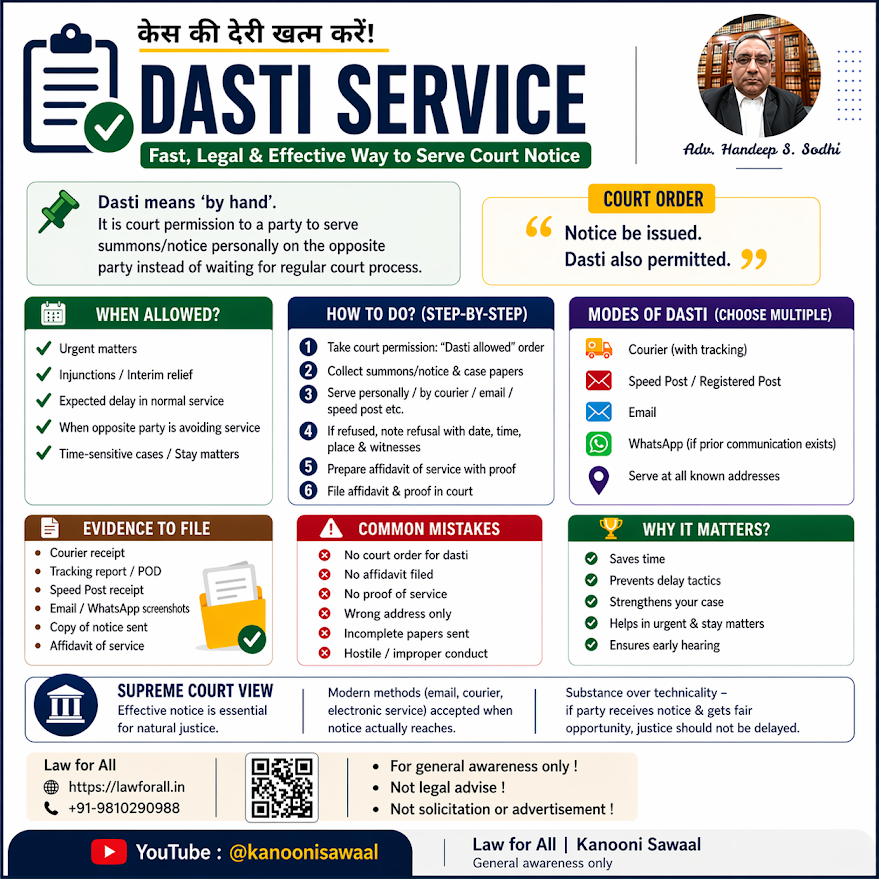
If you have ever heard a judge say, “Notice issued. Dasti also permitted,” you are looking at one of the fastest procedural tools in Indian litigation.
Many cases get delayed because summons do not reach the opposite party on time. Addresses are wrong. Process service takes weeks. Parties avoid service. In urgent matters, waiting for ordinary service can kill the case before it begins.
That is where dasti service becomes powerful.
This post explains what dasti service means, when courts allow it, how to do it properly, whether courier is valid, and what Indian courts including the Supreme Court have said about service of notice. Ths is a general post and specifics may vary from case gto case.
What is Dasti Service?
“Dasti” means by hand. In legal practice, it refers to permission granted by the court to a party to personally arrange service of summons, notice, or court papers on the opposite side, instead of waiting only for regular court process.
In simple words:
- Court issues notice
- Party is allowed to collect copies
- Party serves respondent directly
- Proof of service is later filed in court
Typical court order:
“Issue notice. Dasti service permitted.”
This means normal process may continue, but you are also allowed to ensure quick service yourself.
Why Dasti Service Matters
Litigation delays often begin at the notice stage. If notice is not served, the case cannot move forward.
Dasti service helps because:
- It saves weeks or months
- It reduces evasive tactics
- It helps in stay matters and injunctions
- It speeds up admission hearings
- It creates a clear proof trail
In consumer disputes, civil suits, writ petitions, arbitration matters, and appellate proceedings, this tool is widely used.
When Courts Usually Allow Dasti Service
Courts commonly permit dasti service in:
- Urgent injunction applications
- Interim stay matters
- Time-sensitive commercial disputes
- Cases where normal service is delayed
- Matters involving repeated avoidance by respondent
- Appeals with short limitation pressure
For example, if a builder is about to transfer property or a company is about to encash a bank guarantee, waiting for ordinary summons may defeat the case.
Step-by-Step Process of Dasti Service
- Obtain Court Permission
You need a court order allowing dasti service, unless specific procedural rules already permit it.
- Collect Notice Copies
Take signed summons, notice, petition copy, or paper book from registry.
- Serve the Opposite Party
You may serve by:
- Personal delivery
- Advocate clerk
- Courier
- Speed Post
- Email, if accepted
- Multiple modes together
- If Party Refuses to Accept
Record refusal with date, time, place, witness details. If possible, photograph location or preserve delivery attempt logs.
- Prepare Affidavit of Service
State:
- What was served
- On whom
- Date and time
- Address used
- Mode of service
- Delivery / refusal details
- File Proof in Court
Attach:
- Signed acknowledgment
- Courier receipt
- Tracking report
- Postal receipt
- Email proof
- Screenshots if relevant
Can Dasti Service Be Done Through Courier?
Yes, in many courts and tribunals, courier is accepted as a practical mode, especially when delivery can be proved.
Best practice:
- Use reputed courier with tracking
- Save proof of booking
- Download delivery report
- Preserve POD if available
But do not depend on courier alone where stakes are high.
Use layered service:
- Courier
- Speed Post AD
- WhatsApp where prior communication exists
- Service at registered office and branch office
Courts care less about drama over labels and more about whether actual notice reached the party.
Dasti Service in Consumer Commissions
In consumer forums and commissions, effective notice is critical. If opposite parties dodge service, matters get stuck. In Consumer Commissions, Dasti Service is usually allowed and indeed encouraged.
If a business has shifted address:
- Send to last known address
- Send to invoice address
- Send to registered office
- Send to email used in transactions
This helps defeat later excuses.
Legal Basis for Service of Notice
Though “dasti” is a procedural practice term, service principles arise from:
- Order V CPC ( Civil Procedure Code) which pertains to service of summons. Specifically, Rule 9A pertains to Dasti Service
- Consumer Protection Act and procedural regulations ( Section 65, Regulation 10 and Regulation 24 ).
- Different High Court, Tribunal and Supreme Court Rules and inherent powers of such fora to expedite justice.
Some Important Supreme Court Judgments on Service of Notice and other documents
The Supreme Court recognized procedural fairness and effective notice as core to adjudication. Service is tied to natural justice.
The Court stressed that limitation and procedural consequences may depend on proper communication and receipt of orders.
Core takeaway from different Courts’ trends:
If notice genuinely reaches the party and fairness is preserved, courts lean toward substance over empty technicality.
What Happens After Valid Dasti Service?
If the opposite party still does not appear:
- Court may proceed ex parte
- Interim relief may be considered
- Delay tactics weaken
- Later objections become harder
That is why proper proof of service is gold.
Common Mistakes That Destroy Dasti Service
- No court permission on record
Never assume dasti without order or rule support.
- No affidavit of service
Oral statement is weak.
- No documentary proof
Keep receipts and tracking reports.
- Serving wrong address only
Use all known addresses.
- Incomplete packet sent
Serve the full set of papers.
- Hostile confrontation
Do not create scenes. Stay professional.
Smart Practical Tips
- Carry two sets, one for acknowledgment
- Write names clearly on envelope
- Use date-stamped photos of packet if needed
- Preserve call logs if coordinating delivery
- File affidavit immediately
Sample Court Submission
“Service has been effected pursuant to dasti permission. The respondent was served through courier and email. Proof has been filed.”
Why This Topic is SO IMPORTANT and USEFUL !
Delays weaken any case and may be fatal to justice. Dasti service sounds technical, but it solves a real pain point: cases stuck before hearing starts.
In Conclusion…
Dasti service is not a loophole. It is a speed tool within law.
Used properly, it prevents stalling, strengthens your record, and moves the case forward. Used carelessly, it creates fresh objections.
If the court says “Dasti permitted,” treat it like a legal opportunity. Move fast, document everything, and file proof cleanly.
For many litigants, winning begins with one simple thing: making sure the other side cannot say, “We were never served.”
For legal matters done right, a competent lawyer wins your fight !
For queries and engagements please see the contact us page.
किसी भी प्रश्न और संपर्क के लिए कृपया यह पृष्ठ देखें।